Helga Hayse
Author, Speaker,
Seminar Leader
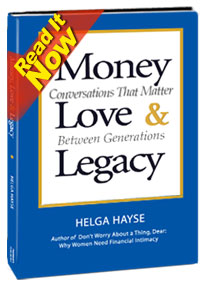
Money, Love & Legacy
A guide to crucial conversations before it’s too late.
Why Families Confuse Money and Love
Why Siblings Fight about Inheritance
Why it's Hard to Talk about Inheritance
What Parents Hide and Adult Children Need to Know
How Will You Be Remembered?
Why You Can't Postpone Apology and Forgiveness
Parents and children don’t like to think that money and love have any relationship to each other. Unfortunately, this is a myth; money insinuates itself into family relationships whether we like to admit it or not.
Parents procrastinate about financial planning and often leave their family with problems about inheritance, responsibility, entitlement, and feelings of regret and anger. They neglect the need for shared medical and legal information and preferences for end-of-life care.
Adult children often feel uncomfortable about opening these conversations with their parents. Both generations need a road map for navigating through these crucial but often uncomfortable subjects.
"Money Love & Legacy" is a guide to show you how to avoid unnecessary guilt, regrets and grief by having the conversations that matter between parents and children before it's too late.
Dreading that Talk with your Parents or Children?
The 40/70 Rule
Today’s most uncomfortable conversations between parents and children aren't about sex. They're about parents sharing with you, their adult children, what you need to know to help them as they age.
A survey conducted by Home Instead Senior Care coined a name for this very important conversation – the 40-70 Rule. It means that children who have reached age 40 or whose parents are 70 need to start discussions about what expectations and responsibilities each will need regarding living arrangements, driving habits, health concerns and financial matters.
Americans need to face up to end-of-life planningBy Special to the Mercury News, January 10th, 2011
This is terrible news for patients and their families who need to open the discussions about end-of-life care. Read more:
http://www.moneyloveandlegacy.com/index.php/media-and-press/86-article-mercury-news-111.html
HOW NOT TO DIE
http://www.theatlantic.com/magazine/archive/2013/05/how-not-to-die/309277/
CHANGING YOUR ADVANCE MEDICAL DIRECTIVE
The American Bar Association Commission on Law and Aging suggests that you re-examine your health care wishes whenever any of the following “five D’s” occurs:
- Decade: When you start each new decade of your life.
- Death: When you experience the death of a loved one.
- Divorce: When you experience a divorce or other major family change. (In many cases, a divorce automatically revokes the authority of a spouse who had been named as agent.)
- Diagnosis: When you are diagnosed with a serious medical problem.
- Decline: When you experience a significant decline or deterioration from an existing health condition, especially when it diminishes your ability to live independently.
If you decide to change something in your living will or health care power of attorney, the best thing to do is create a new one. Once this new document is signed and dated in front of appropriate witnesses, and notarized if necessary, it supersedes your old directive.
For more advice on creation and maintenance of your living will and other advance directive documents, purchase The Health Care Power of Attorney and Living Wills from Harvard Medical School.
WHAT OLDER ADULTS NEED TO AGE IN PLACE
Seven attributes communities need to be attractive to older adults, according to a MetLife Mature Market Institute study done with the Stanford Center on Longevity.
- Housing. Affordable housing with zoning laws that permit flexible housing arrangements (assisted living facilities or houses on small lots).
- Transportation. Mass transit, senior transportation programs, walkable neighborhoods, nearby parks and recreation.
• Safe neighborhoods. Low crime rates, emergency preparedness plans.
• Health care. An adequate number of doctors who take Medicare, specialists, hospitals and preventive health care programs.
• Supportive services. Meals on wheels, adult day care, home care giving support.
• Goods, amenities. Retail outlets within walking distance, restaurants, grocery stores with healthy foods, farmers markets.
• Social integration. Places of worship, libraries, museums, colleges and organizations that promote intergenerational contact.
http://www.cnbc.com/id/100549801
WHEN PARENTS DIE: UNFINISHED BUSINESS
Subscribe to Helga's Blog
What Readers Say
- S Gilbert
- M Charles
- E. Charnes
- T Meesue
- B Crary